Smart karaoke · six languages · ages 3 to 12 and the whole family

The rhythm of language learning

Songs for learning languages. The lyrics light up word by word, your child understands what they are singing and dares to say it out loud.

Join the waiting list
  • Coming soon to Google Play
  • Coming soon to App Store

No ads · Minimal data about your child · Their voice is not stored

Silent video of the FonoBeat app on a phone: the lyrics of a song light up word by word.
Practice modes

From play to challenge, at their own pace

Three ways to work the same song, ordered from least to most brave.

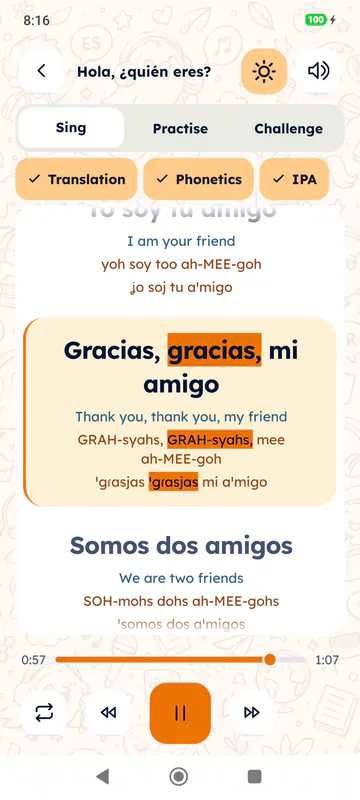
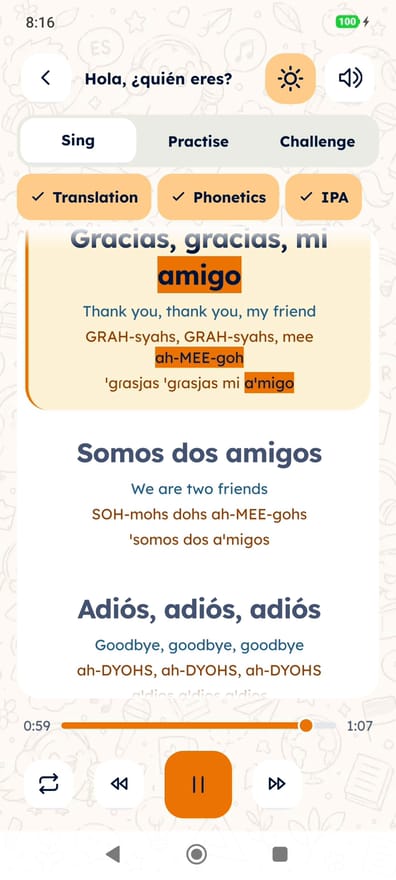
  1. FonoBeat app, Sing screen: the lyrics of a song in Spanish with, under each line, its translation, how to say it and the IPA.

    Every plan

    Sing

    Free karaoke with the synced lyrics and its reading layers. To enjoy the song, train the ear and lose the fear.

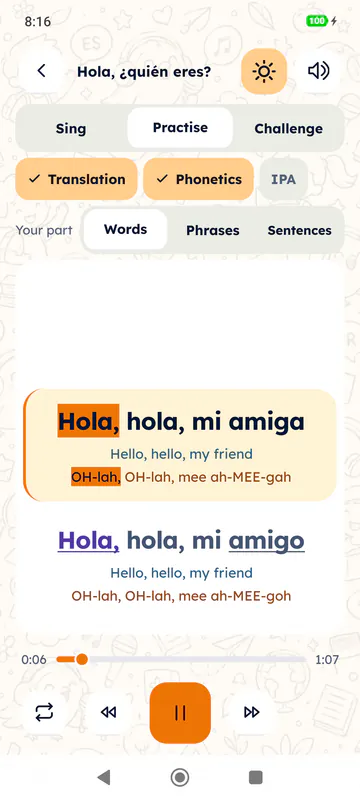
  2. FonoBeat app, Practise screen: the lyrics of a song in Spanish with some words underlined; those are the ones your child sings.

    Words · phrases · sentences

    Practise

    The voice drops out on some words, phrases or sentences and your child fills them in by singing. Pick the level and repeat as often as needed; it doesn’t use up Challenges.

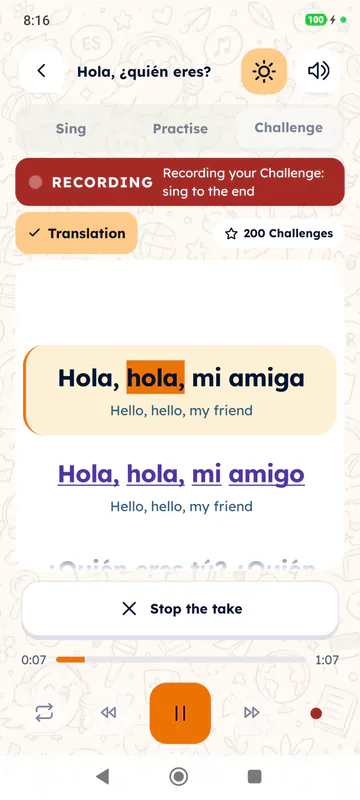
  3. FonoBeat app, Challenge screen: a red bar shows it is recording while your child sings a song in Spanish.

    Challenges by plan

    Challenge

    The final test: singing without the written pronunciation, with a grown-up’s permission. The AI listens to some passages and gives kind feedback on what already sounds good and what’s worth another go.

How it works, step by step

Pick the language

Every language, with songs of its own

Pick one and look at the first song your child will sing.

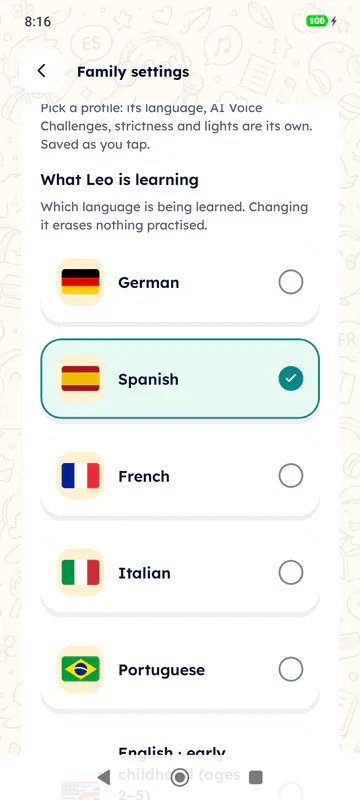
Language they want to learn

Learning Spanish by singing

First song Hola, ¿quién eres?

What is sung

Hola, hola, mi amiga

What it means

Hello, hello, my friend

How to say it

OH-lah, OH-lah, mee ah-MEE-gah

The stressed syllable is in CAPITALS.

How it sounds, in phonetic alphabet

ˈola ˈola mi aˈmiga

Learning French by singing

First song Bonjour, mon ami

What is sung

Bonjour, bonjour, mon ami

What it means

Hello, hello, my friend

How to say it

bohn-ZHOOR, bohn-ZHOOR, mohn ah-MEE

The stressed syllable is in CAPITALS.

How it sounds, in phonetic alphabet

bɔ̃ʒuʁ bɔ̃ʒuʁ mɔ̃ ami

Learning German by singing

First song Hallo, mein Freund

What is sung

Hallo, hallo, mein Freund

What it means

Hello, hello, my friend

How to say it

HAH-loh, HAH-loh, mine froynt

The stressed syllable is in CAPITALS.

How it sounds, in phonetic alphabet

ˈhalo ˈhalo maɪn fʁɔʏnt

Learning Italian by singing

First song Ciao, amico mio

What is sung

Ciao, ciao, amico mio

What it means

Hello, hello, my friend

How to say it

chow, chow, ah-MEE-koh MEE-oh

The stressed syllable is in CAPITALS.

How it sounds, in phonetic alphabet

ˈtʃao ˈtʃao aˈmiko ˈmio

Learning Brazilian Portuguese by singing

First song Olá, meu amigo

What is sung

Olá, olá, meu amigo

What it means

Hello, hello, my friend

How to say it

oh-LAH, oh-LAH, MEH-oo ah-MEE-goo

The stressed syllable is in CAPITALS.

How it sounds, in phonetic alphabet

oˈla oˈla mew aˈmigu

Try the demo

Safety first

Made for children. Designed for grown-ups' peace of mind.

  • Minimal data about your child

    Three things are stored about your child: nickname, age and progress. There's no field for their legal name, ID or location, and the account belongs to the adult.

  • No advertising

    Zero ads and zero trackers. Nobody is selling your child anything inside FonoBeat.

  • Their voice isn't stored

    The audio leaves the phone to be assessed, is compared with the reference and discarded: it stays on no server. The result is kept, not the sound.

  • Our own content

    Songs written and curated for learning: useful vocabulary, age-appropriate lyrics, no surprises.

All the safety and privacy, explained for parents

Frequently asked questions

What ages is FonoBeat for?

It's built for children aged 3 to 12 who are starting out with a language. It also works for teenagers and adult beginners who'd rather practise by singing than through grammar drills — the embarrassment of pronouncing has no age limit. The catalogue includes an adult line with its own settings.

Does it work if I do not speak the language my child is learning?

Yes, and it is a very common case. Every line shows its translation into your language and its pronunciation written with your own letters, so you can follow the practice and understand what your child is singing without knowing the language. The app never assumes the adult speaks it.

What happens to my child's voice when the app listens?

It leaves the phone to be assessed: it travels encrypted to our server and to Microsoft Azure Speech, the external service that assesses it on the spot. Neither of them stores it, and we don’t use it to train any system. Only the result of the practice is kept, the stars from a Challenge, for example. We explain it in detail on the safety page.

Does it work offline?

Today practice needs a connection — Challenges in particular, because the pronunciation assessment happens in the cloud.

Where do I download the app?

The app is coming soon to the App Store and Google Play. When it's there, the links will appear on this site. In the meantime you can try the interactive karaoke demo here on the web, with nothing to install.
See all the questions

Join the list and we'll let you know

The app is coming to the stores soon. Tell us which language your child wants to learn and we'll write to you on launch day. No account, no card, no newsletter.

We'll let you know when it's ready

Rather write to us?

The form is the quick way, not the only one: a person reads this inbox.

contact@fonobeat.com
  • Coming soon to Google Play
  • Coming soon to App Store

Running a school or nursery? Take a look at FonoBeat for Schools.